Ikigai: Finding Meaning in Everyday Life
What makes your eyes light up when you talk about it?
When I wrote the first version of this article, I was on holiday by the sea, in the places where I had spent so many summers with my family. I had just closed my practice for the summer and finally had time to reflect on the experiences of the past few months. A friend had told me about ikigai, a Japanese word often translated as “a reason to get up in the morning”.
It struck me because it gave a name to something I already felt: the pleasure of putting time and energy into what matters to me.
What does ikigai mean?
Ikigai describes what makes life meaningful and worth living. It may be someone we care for, a desire to learn, an activity we love or a project we believe in. It also includes the small things that make a day feel precious. [1]
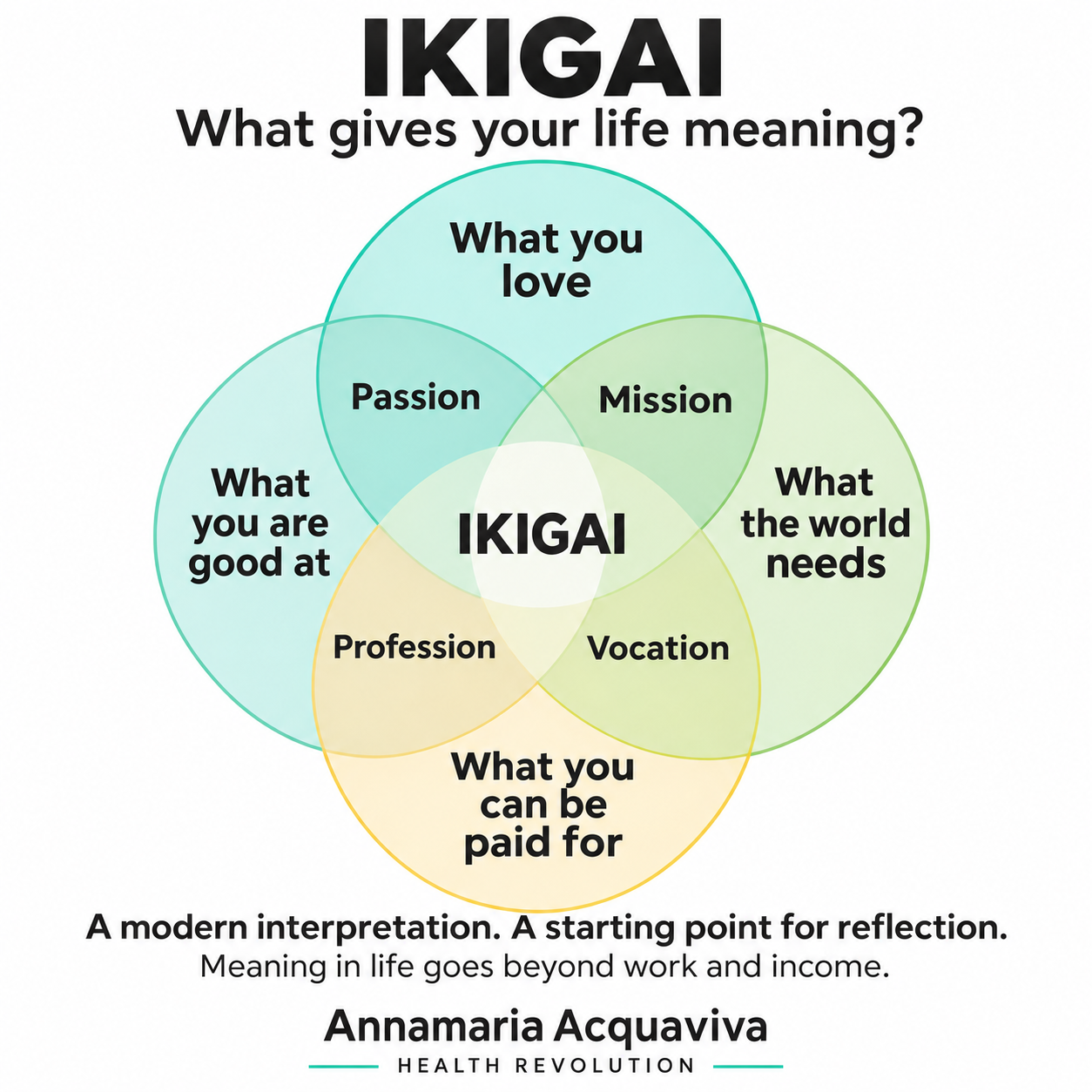
If you have come across the word before, you may remember the diagram with four circles: what you love, what you are good at, what the world needs and what you can be paid for. I used it in the original article too. It is an interesting starting point, but it needs a little context: this is a modern interpretation, rather than the original meaning of ikigai. What gives our lives value does not have to become a career or earn us an income. [1]
Ikigai, purpose and wellbeing: what research tells us
As a dietitian nutritionist and pharmacist, I am also interested in what research can tell us about this.
In July 2026, a meta-analysis published in Psychological Medicine brought together data from almost 489,000 people, with follow-up periods of up to 32 years. A stronger sense of purpose in life was associated with a lower risk of death. Purpose in life is closely related to ikigai, although it does not capture all its nuances. [2]
A 2022 study of Japanese adults aged 65 and over had already found that those who reported having ikigai went on to experience greater life satisfaction, fewer depressive symptoms and a lower risk of developing functional disability. [3]
These are interesting findings, and they deserve careful interpretation. The studies show associations: they do not prove that finding your ikigai makes you live longer. Health, living conditions, relationships and habits can influence both our wellbeing and our ability to spend time doing what we love. [2], [3]
Another study, published in August 2026, adds something I find particularly meaningful: among 504 older Japanese adults, richer social interaction was associated with a greater likelihood of reporting ikigai three years later. This is a study in a specific group, but it suggests that opportunities to meet others and take part in shared activities may also matter to our sense of meaning. [4]
What gives my own days meaning
For me, much of that meaning comes from curiosity. I love communicating, reading, laughing, singing and dancing. And I still find pleasure in studying health, nutrition and human behaviour.
I am fortunate to do work I love. Studying, considering scientific knowledge alongside practical experience and making it useful to people is what I enjoy, whether I am working with patients, sharing health information or fulfilling my role as Scientific Director of Palazzo di Varignana.
I also pay close attention to these aspects in my work with patients. Inner harmony is the second pillar of the Acquaviva Method, the scientific approach to health and wellbeing that guides my work. It also means cultivating awareness, making time for meditation and recognising what gives our lives meaning, while respecting each person’s values and beliefs.
Taking time to recognise what matters is something I also explored in the account of my Camino de Santiago.
Alongside my professional work, I felt a desire to devote time and expertise to helping children and families. In the first version of this article, I announced a project I was passionate about: that project was Health4Children.
That idea led to Project BATMAN, carried out with IRST, and the health education initiatives developed with the Istituto Oncologico Romagnolo, including “IOR Mangio sano, con più gusto!” and “Sano, giusto e con gusto!”. The aim is to make scientific knowledge understandable and useful in the everyday lives of children and their families.
For me, this is ikigai too: using what I know and love doing to contribute to something I believe in, together with other people.
And you? What would you like to make more time for? Perhaps there is an interest you keep putting off, a relationship you would like to nurture or a project you often find yourself thinking about. You can start there, by setting aside a little time for it during your week.
The question I ended this article with all those years ago still feels like the right one: what makes your eyes light up?
Scientific references
- Sartore M. et al. An Integrated Cognitive-Motivational Model of Ikigai (Purpose in Life) in the Workplace. Europe’s Journal of Psychology, 2023.
- Sutin A. et al. Purpose in life and mortality: A meta-analysis of the published literature and individual-participant data of 488,765 participants followed for up to 32 years. Psychological Medicine, 2026;56:e214. DOI: 10.1017/S0033291726104863.
- Okuzono S.S. et al. Ikigai and subsequent health and wellbeing among Japanese older adults: Longitudinal outcome-wide analysis. The Lancet Regional Health – Western Pacific, 2022.
- Pei Y. et al. Beyond Continuity: A Binary-Outcome Cross-Lagged Panel Model of Ikigai and Social Interaction Among Community-Dwelling Older Adults. Geriatrics & Gerontology International, 2026;26(8):e70755. DOI: 10.1111/ggi.70755.
MY NEWSLETTER
For more insights into nutrition, wellbeing and longevity, join me in my newsletter.
Can I help you?
Health Revolution: the 5 pillars of health
The book where I collected tools and strategies to apply my scientific method based on the 5 pillars of health.
How to achieve balance between body and mind, helping us face life's challenges.